Coin Inventory Log: Streamlining Numismatic Tracking and Collection Management
Managing a coin collection often starts with enthusiasm but quickly becomes complicated without a dedicated system. A Coin Inventory Log serves as the foundational tool for anyone serious about numismatics, transforming a scattered assortment of metal discs into a curated, valuable portfolio. Rather than relying on memory or disjointed digital notes, this physical log provides a structured environment to record essential data points such as mint marks, grading, acquisition costs, and current valuations. For collectors, dealers, and estate managers, having a tangible record is not just about organization; it is about preserving the provenance and financial integrity of the assets.
Real-World Applications for Serious Collectors
The primary audience for a specialized inventory log includes hobbyists who have moved beyond casual accumulation and are now focused on specific series or historical periods. Consider the collector focusing on Morgan Silver Dollars or Walking Liberty Halves. These individuals need to track subtle variations that significantly impact value. A generic notebook lacks the specific columns required for this level of detail. By using a pre-formatted Coin Inventory Log, these collectors can instantly compare their holdings against standard reference guides without redesigning their tracking system every time they acquire a new piece.
This tool also proves invaluable during coin shows and auctions. When browsing through dealer tables or bidding in live auctions, the ability to quickly reference what you already own prevents duplicate purchases and helps identify gaps in a set. The physical nature of the log means there is no reliance on battery life or internet connectivity in crowded convention centers where signals often fail. Having a printed inventory allows for immediate cross-referencing, ensuring that buying decisions are based on accurate, up-to-date personal records rather than guesswork.
Estate Planning and Insurance Documentation
Beyond active collecting, a Coin Inventory Log plays a critical role in risk management and legacy planning. Insurance providers typically require detailed itemization before covering high-value collections. A professionally formatted log provides the exact structure adjusters look for, including spaces for certification numbers from grading services like PCGS or NGC. In the unfortunate event of theft or loss, this documented evidence accelerates claims processing and ensures fair compensation based on recorded grades and purchase prices.
Similarly, families managing an inheritance often face the daunting task of cataloging a deceased relative’s collection. Without a prior inventory, heirs may inadvertently sell rare key dates for melt value because they lack the knowledge to identify them. A completed log acts as a roadmap for executors, clearly indicating which items hold significant numismatic premium versus those that are merely bullion. This clarity reduces family disputes and ensures the collection is liquidated or preserved according to the original owner's intent.
Technical Specifications for KDP Publishing Success
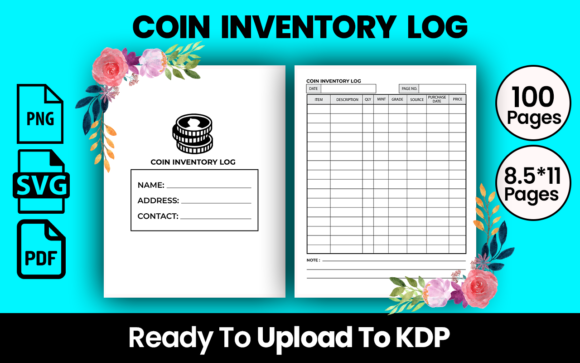
For entrepreneurs and publishers looking to offer this resource to the numismatic community, technical precision is non-negotiable. This specific Coin Inventory Log interior is engineered for seamless integration with Amazon KDP, eliminating the common formatting errors that lead to rejected uploads or poor customer reviews. The trim size is set to the industry-standard 8.5″ x 11″, providing ample writing space for detailed annotations while remaining portable enough for travel to coin clubs or shops.
The file package includes three distinct variants to maximize utility and market reach:
- PDF Format: The primary file ready for direct upload to KDP. It features 100 pages of consistent, high-resolution formatting optimized for print-on-demand production.
- PPT Source File: Allows sellers to customize headers, add branding, or modify column widths to create niche-specific versions, such as ancient coin logs or error coin trackers.
- PNG Files: High-quality image files useful for creating marketing mockups, social media previews, or digital download bundles for customers who prefer printing at home.
Crucially, this interior is designed with no bleed specifications. This ensures that all content stays safely within the printable area, preventing text or lines from being trimmed off during the manufacturing process. The 100-page count strikes an ideal balance between perceived value and printing cost, keeping the retail price competitive while offering sufficient capacity for substantial collections.
Adapting the Log for Different Numismatic Niches
While the core structure suits general collectors, different segments of the market utilize inventory logs in unique ways. Bullion investors, for example, prioritize weight, purity, and spot price correlation over mint marks or variety attribution. They benefit from the log’s ability to track aggregate metal content and average cost basis, which is essential for tax reporting when selling precious metals. The flexibility of the PPT source file enables creators to tailor the interior specifically for stackers, adding columns for ounce totals and storage locations.
Conversely, ancient coin collectors operate in a completely different paradigm where provenance and pedigree outweigh standardized grading. For this demographic, the inventory log serves as a historical ledger. Users might repurpose standard fields to record auction house references, previous owners, or archaeological context. Understanding these divergent needs highlights why offering a customizable template is often more valuable than a rigid, one-size-fits-all product. The ability to adapt the base 100-page interior allows sellers to capture multiple micro-niches within the broader coin collecting market.
Practical Considerations Before Implementation
Before adopting or publishing a Coin Inventory Log, users should evaluate their specific workflow requirements. Physical logs excel at permanence and focus but lack the search functionality of digital databases. Many experienced collectors adopt a hybrid approach, using the physical book as the master archive and a simple spreadsheet for quick filtering. Recognizing this behavior, the design of this KDP interior emphasizes clean, legible layouts that facilitate easy transcription to digital formats if needed later.
Publishers must also consider the paper quality implications of KDP’s standard white paper. While suitable for ballpoint and pencil, heavy markers or fountain pens may cause bleed-through. Advising customers to use appropriate writing instruments enhances user satisfaction and protects the integrity of the inventory. Additionally, while the 8.5″ x 11″ size is standard, some users prefer smaller field guides. Offering the PNG variant allows tech-savvy customers to resize or reformat pages for personal use, adding versatility to the product offering.
For those entering the low-content book market, differentiation is key. Simply uploading a generic grid is rarely sufficient. Successful sellers leverage the included PPT file to add educational value, such as grading reference charts, mint mark identification guides, or glossaries of numismatic terms on the first few pages. This transforms a simple Coin Inventory Log from a commodity into a comprehensive resource guide. The combination of ready-to-print PDFs and editable source materials provides the foundation for building a sustainable brand in the numismatic publishing space, serving both the practical needs of collectors and the creative goals of independent publishers.