Check Register Book: A Practical Guide to KDP Interiors and Financial Tracking
Managing personal or small business finances requires consistent tracking, and for many, a physical Check Register Book remains the most reliable tool for maintaining accurate records. While digital banking offers convenience, it often lacks the tactile accountability of writing down transactions in real-time. For entrepreneurs and creators in the low-content publishing space, this enduring need presents a significant opportunity. However, success in this niche depends less on the concept itself and more on the technical execution of the interior file. Understanding the specific requirements of a high-quality register ensures that whether you are creating one for sale or selecting one for personal use, the final product serves its intended purpose without frustration.
The Enduring Value of Physical Financial Records
A check register is more than just a place to record check numbers; it is a comprehensive ledger for monitoring cash flow, deposits, withdrawals, and running balances. Despite the prevalence of fintech apps, adults aged 20 to 50 continue to seek out physical registers for budgeting, estate planning, and small business accounting. The act of manually recording expenses creates a psychological connection to spending habits that automated alerts simply cannot replicate.
For KDP publishers, this translates to steady demand. However, the market is saturated with poorly designed interiors that fail to account for actual user behavior. A functional Check Register Book must provide adequate writing space, clear column headers, and a layout that accommodates various handwriting sizes. When evaluating or designing these books, the focus must remain on utility over aesthetic novelty. If the columns are too narrow or the paper quality makes ink bleed-through inevitable, the book becomes useless regardless of how attractive the cover appears.
Common Technical Mistakes in KDP Interiors
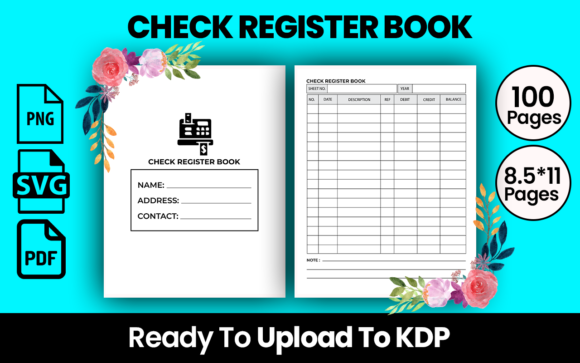
One of the most frequent errors creators make when preparing a financial tracker for Amazon KDP involves misunderstanding trim sizes and bleed settings. This specific interior is formatted at 8.5″ x 11″ with no bleed. This distinction is critical. Many beginners mistakenly select "bleed" during the upload process because they assume all professional books require it. However, a standard check register typically keeps all content within safe margins. Uploading a no-bleed PDF as a bleed file can result in shifted content, cropped headers, or rejected files.
Another pervasive issue is file format confusion. Having access to multiple variants—PPT, PDF, and PNG—is advantageous, but only if used correctly. The PDF is the industry standard for KDP printing and should be your primary upload file. It locks fonts, lines, and spacing in place. Using a PPT file directly for upload is risky; PowerPoint is a presentation tool, not a print production tool. Fonts may substitute, and line weights can change during conversion. Similarly, while PNG files are excellent for marketing mockups or digital previews, they are generally unsuitable for the interior manuscript due to resolution limitations and lack of embedded font data. Always verify that your final upload is a flattened, high-resolution PDF.
Overlooking Page Count and Usability Balance
This interior contains 100 pages, which is a strategic sweet spot for financial journals. A common mistake in low-content publishing is maximizing page count solely to increase perceived value. A 200-page check register is often too bulky for daily carry or desk use, leading to customer returns or negative reviews citing poor portability. Conversely, books under 80 pages may feel insubstantial. Before finalizing your product, consider the practical lifespan of the book. One hundred pages typically covers three to six months of moderate transaction volume, making it a realistic duration for a single volume.
Evaluating Layout Variants and Column Structures
Not all check registers serve the same audience. A frequent oversight is assuming a single-column layout fits every user. When choosing or designing an interior, examine the specific fields included. Does it have a dedicated column for fees? Is there space for transaction codes or reference numbers? Small business owners often require different fields than individuals balancing a personal checking account.
- Standard Personal Registers: Typically include Date, Description, Payment/Debit, Deposit/Credit, and Balance.
- Business Ledgers: May require additional columns for Invoice Numbers, Tax Categories, or Vendor IDs.
- Savings Trackers: Often prioritize Goal Amounts and Interest Earned over transaction frequency.
If you are utilizing a pre-made interior with three different variants, test each one against real-world scenarios. Print a sample page and write in it with a standard ballpoint pen. Ensure the row height allows for legible handwriting without cramping. Digital screens can be deceptive; what looks spacious on a monitor may feel claustrophobic on printed paper. Correcting this before publication saves costly reprints and protects your author reputation.
Avoiding Quality Issues in Low-Content Publishing
Beyond technical specifications, the presentation of the interior dictates customer satisfaction. A major pitfall is using pure black (#000000) for grid lines and text. On KDP’s standard white paper, pure black can sometimes appear harsh or cause slight ghosting on the reverse side. Experienced designers often use a dark gray (e.g., #333333 or #444444) for table lines. This reduces visual fatigue and improves the overall reading experience without sacrificing contrast.
Additionally, ensure that the "Balance" column is positioned intuitively. In some poorly designed templates, the balance column is placed on the far left or buried between debit and credit columns, disrupting the natural left-to-right calculation flow. Users should be able to scan across the row logically: Date → Description → Outflow → Inflow → New Balance. Disrupting this cognitive pattern leads to calculation errors and user frustration. Always prioritize functional ergonomics over creative layout experimentation when dealing with financial tools.
Verifying File Integrity Before Upload
Even with a perfectly formatted template, corruption can occur during export or transfer. Before uploading any Check Register Book interior to KDP, perform a thorough quality check. Open the PDF in multiple viewers to ensure consistency. Zoom in to 100% to verify that lines are crisp and text is sharp, not pixelated. Check the document properties to confirm the page size matches exactly 8.5 x 11 inches. Even a fraction of an inch discrepancy can trigger automated rejection or result in unwanted scaling.
If you are modifying the provided PPT source file, remember to reset master slides and check for hidden objects. Sometimes, leftover elements from previous edits can shift during PDF export. Flattening the final PDF is a best practice that prevents layers from moving and ensures that transparency effects render correctly in print. Taking these extra ten minutes of verification prevents days of delay in the approval process.
Making Informed Decisions for Long-Term Success
Whether you are a freelancer tracking income, a parent teaching financial literacy, or a publisher building a catalog, the effectiveness of a check register lies in its attention to detail. Avoid the temptation to treat this as a generic commodity. The difference between a bestseller and a forgotten listing is often the thoughtful correction of small usability issues.
When comparing options, look beyond the price or the number of pages. Evaluate the margin safety, the clarity of instructions on the first page, and the appropriateness of the column widths for your specific demographic. For creators, leverage the included PDF variant for production, use the PNG for compelling advertising, and reserve the PPT only for necessary customization. By respecting the technical constraints and user needs inherent in financial tracking tools, you ensure that the final product delivers genuine value. A well-executed Check Register Book is not just a notebook; it is a trusted instrument for financial stability, and treating it with professional rigor yields the best results for both maker and user.